Problem
In the design process, the biggest challenge is accurately replicating irregular and organic shapes. Manual measurements using calipers and traditional tools are insufficient, highly time-consuming, and carry a high risk of error. This typically results in costly design revisions and a lack of perfect fitment with the target mechanical assembly.
Solution: Reverse Engineering
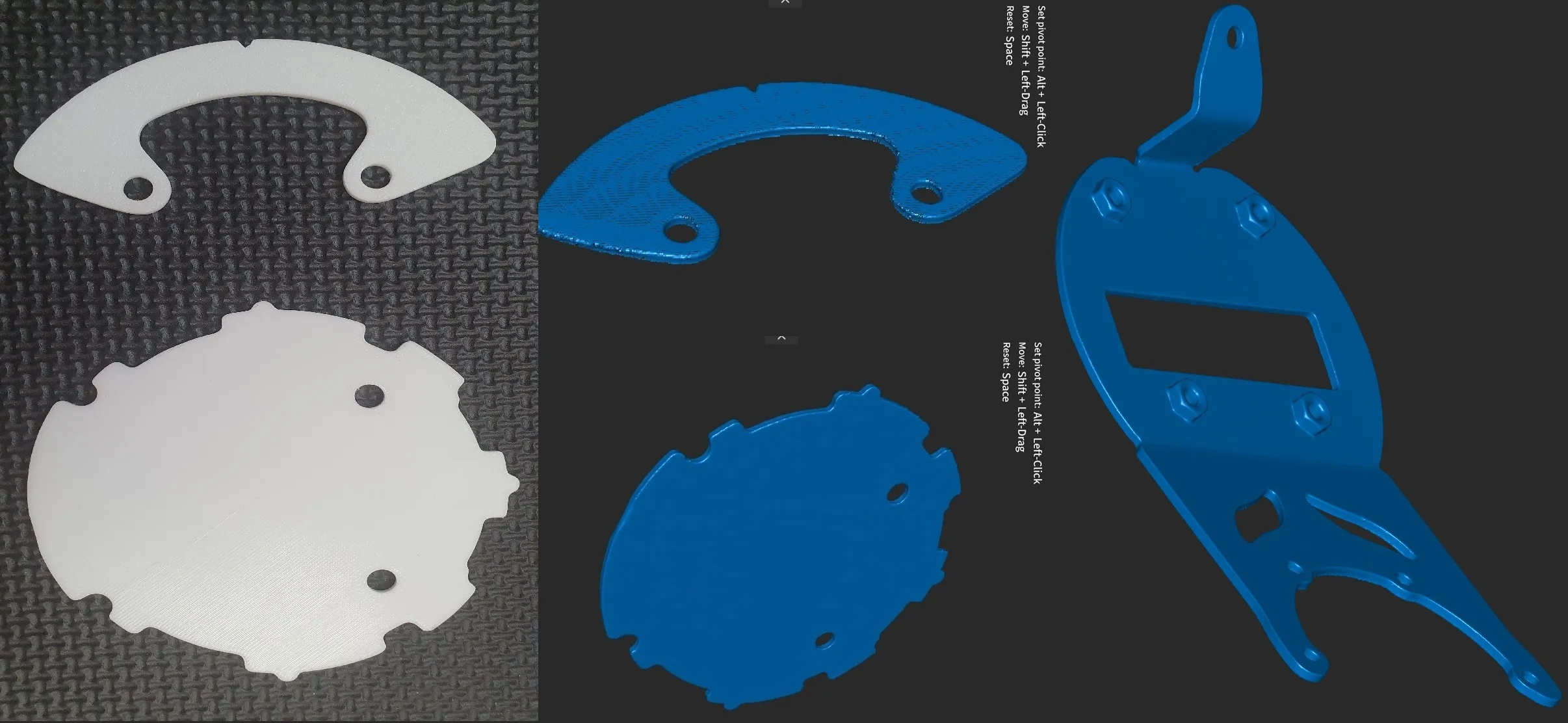
To guarantee high compatibility, a full Reverse Engineering process was implemented. The original mounting components were subjected to 3D scanning. The resulting spatial mesh served as the perfect baseline for reconstructing the geometry and locating mounting holes within the CAD environment.
To physically verify the dimensional accuracy, models were fabricated using 3D printing technology (FDM). It is important to emphasize that the prints created in this project were not designed to bear mechanical loads; they act strictly as physical verification prototypes. This allows the part to be placed on the target assembly for a "live" fitment test before initiating actual production with expensive materials.
Business Applications
This workflow—from 3D scanning, through CAD modeling, to creating an inexpensive control part—drastically reduces the costs and duration of the R&D (Research & Development) phase. These types of services are ideal when:
- designing aftermarket accessories for complex mechanisms already existing on the market is required,
- a company wants to avoid the risk of costly errors before commissioning final production (e.g., expensive CNC aluminum machining or creating injection molds),
- designers and engineers need to test the ergonomics and assembly mechanics in the real world in just a few hours after identifying the requirement.